Quick Facts
- Annual Cost: Over $1.2 billion globally in damages to the aviation industry.
- Strike Frequency: 22,372 wildlife strikes reported in the U.S. in 2024 alone.
- Risk Window: 60% to 96% of incidents occur during takeoff or landing phases.
- Trend Analysis: A 14% increase in reported strikes between 2023 and 2024.
- Night Hazard: Collisions are approximately 7 times more dangerous in low-light conditions.
- Fatalities: Over 643 human lives lost globally due to wildlife strikes since 1990.
Bird strikes are a daily reality in aviation, occurring most frequently during takeoff and landing when aircraft share lower altitudes with wildlife. While most incidents involve small birds and cause minimal damage, they pose a significant economic burden, costing the industry over $1 billion annually. Pilots are trained to manage these events, often returning for inspections to ensure flight instrument integrity.
The Sensor Threat: Why Small Birds Pose a 'Quiet' Risk
To a passenger in row 12, a bird strike might manifest as nothing more than a dull thud or a momentary vibration. However, on the flight deck, even a collision with a single small bird can trigger a complex chain of technical challenges. One of the most insidious risks is not structural failure, but the compromise of the aircraft’s sensory nervous system.
Modern jets rely on Pitot tubes and static ports—small, calibrated probes mounted on the fuselage—to measure airspeed and altitude. When a bird impacts these sensors, it can lead to an unreliable airspeed scenario. For a pilot, this is a high-workload emergency where the primary flight displays may show conflicting information. Maintaining flight deck awareness becomes paramount as the crew must discern which instruments are functioning and which have been compromised by the impact.
The sensory experience of a bird strike is often described by pilots as a big thump that can be felt through the airframe. Regardless of whether an immediate problem is detected, a post-strike inspection is mandatory. This is because the kinetic impact energy of even a small bird at 250 knots can cause hairline fractures in composite materials or subtly displace a sensor, leading to gradual failures later in the flight. The bird strike risk during takeoff and landing is particularly high because this is when the aircraft is transitioning through the most densely populated avian altitudes, often while the crew is managing high communication and navigation loads.
High-Stakes Impact: Engines, Airframes, and Kinetic Energy
While sensor damage is a "quiet" risk, engine ingestion represents the most dramatic and dangerous form of bird strike. Modern turbofan engines act like massive vacuum cleaners, pulling in enormous volumes of air to generate thrust. If a bird, or a flock of birds, is drawn into the intake, the results can be catastrophic. The internal components of an engine—specifically the fan blades—are moving at supersonic speeds. When a bird enters this environment, the bird strike damage to aircraft engines can range from minor blade bending to a total dual-engine flameout.
The physics behind these collisions is governed by kinetic energy, which increases with the square of the velocity. An eight-pound bird hit by an aircraft traveling at 150 miles per hour exerts the force of a roughly 15-ton weight dropped from a height of ten feet. Because of this, airframe certification requires manufacturers to prove that their aircraft can withstand strikes from birds of specific weights without losing structural integrity or the ability to fly.
The most famous example of this risk is the 2009 "Miracle on the Hudson," where an Airbus A320 ingested a flock of Canada geese into both engines shortly after takeoff. This incident proved that while can bird strike caused plane crash scenarios are rare, they are entirely possible if both powerplants are disabled simultaneously. According to the International Civil Aviation Organization, bird strikes cause an estimated $1.2 billion in damages to the global aviation industry every year, a figure that includes both physical repairs and the massive operational costs of flight cancellations and delays.
The 13-Mile Gap: Airport Boundaries vs. Flight Corridors
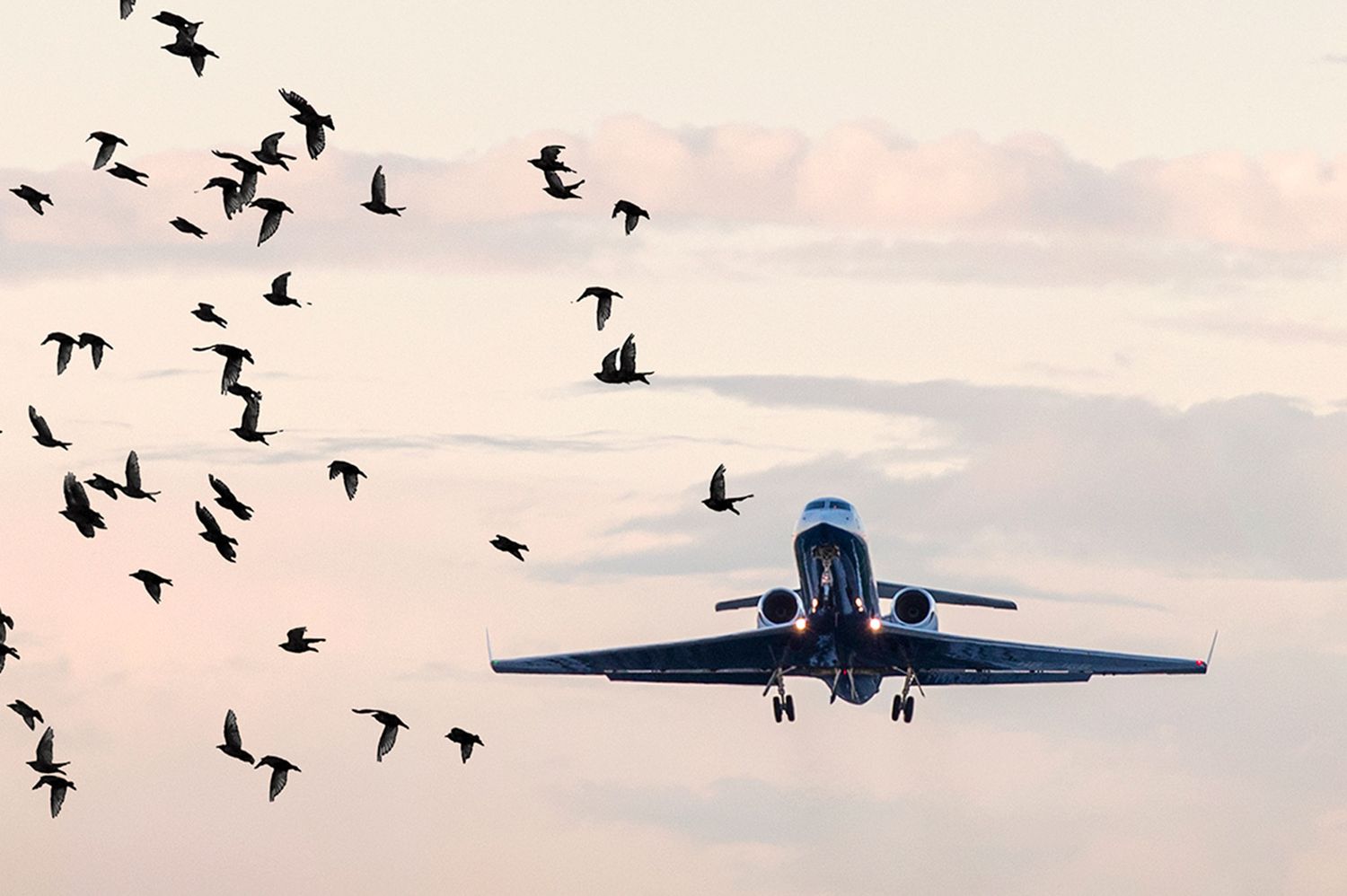
A significant challenge in wildlife hazard management is the spatial mismatch between airport jurisdiction and where birds actually fly. While airport authorities can control the immediate environment within their perimeter—often referred to as FAA Part 139 compliance in the United States—they have little to no control over the land use outside their fences.
Statistics reveal a troubling trend: while the majority of strikes occur on airport grounds, the most damaging incidents often happen during the approach and departure phases, up to 13 miles away from the runway. The Federal Aviation Administration reported 22,372 wildlife strikes involving U.S. civil aircraft in 2024, representing a 14% increase from the previous year. This suggests that as urban sprawl and environmental restoration projects create more bird-friendly habitats near cities, the risk to aircraft increases.
To address how to prevent bird strikes on aircraft in these "uncontrolled" corridors, regulators emphasize habitat modification and strict land-use planning. The ICAO bird strike management guidelines suggest that garbage dumps, wetlands, and certain agricultural activities should be kept far from flight paths to minimize the attraction of large bird populations. Since 1990, wildlife strikes have resulted in more than 643 human fatalities and the destruction of over 360 aircraft globally, highlighting that aerodrome safety is a shared responsibility between airport managers and local municipal planners.
| Area of Control | Mitigation Strategy | Effectiveness |
|---|---|---|
| Inside Airport Fence | Grass management, sirens, pyrotechnics | High (Reduces 80% of low-level strikes) |
| Approach Corridors | Land-use zoning, avian radar monitoring | Moderate (Harder to enforce) |
| En Route (High Altitude) | Flight path adjustments | Low (Strikes are rare but severe) |
Future Defense: AI Detection and Pulsing Lights
The aviation industry is moving toward a more proactive, technology-driven approach to wildlife safety. Traditional methods of scaring birds away with "bird cannons" or trained hawks are being supplemented by AI bird strike detection systems. These systems use high-definition cameras and computer vision models to identify birds in real-time, allowing controllers to delay a takeoff if a flock is crossing the runway's departure path.
Furthermore, avian radar technology is becoming more sophisticated, capable of tracking thousands of individual birds simultaneously and predicting their migration patterns. This data allows airlines to adjust their schedules during peak migration seasons, significantly reducing the economic impact of bird strikes on aviation.
Innovations aren't limited to ground-based tech. On the aircraft itself, manufacturers are experimenting with pulsing landing lights. Research has shown that birds are more likely to perceive and avoid an aircraft if its lights are flashing at specific frequencies. For example, Qantas reported a 66% reduction in strikes after implementing pulsed lighting on parts of its fleet. As climate change alters bird migration routes, the ability to adapt in real-time using these advanced technologies will be the key to maintaining aviation's stellar safety record.
FAQ
Can a plane survive a bird strike?
Yes, the vast majority of aircraft survive bird strikes with little to no damage. Modern planes are designed and tested to withstand significant impacts. Most strikes involve small birds that do not compromise the structural integrity of the airframe or the functionality of the engines. Pilots are trained to land the aircraft safely even if one engine is affected.
What was the worst bird strike in history?
The most significant bird strike in terms of fatalities occurred in 1960, when Eastern Air Lines Flight 375 crashed in Boston after ingesting a flock of starlings into three of its four engines shortly after takeoff. The crash resulted in 62 fatalities. This event led to significant changes in engine design and bird ingestion testing standards.
What causes bird strikes on planes?
Bird strikes are caused by the co-location of aircraft and wildlife in the same airspace, particularly at lower altitudes. Factors include the presence of attractants like water, food, or nesting sites near airports, as well as the increasing speed and quietness of modern jet engines, which may give birds less time to react and fly away from an approaching plane.
How do pilots avoid bird strikes?
Pilots avoid bird strikes by following airport advisories regarding bird activity and using radar data when available. During periods of high activity, they may delay takeoffs or use steeper climb gradients to exit bird-populated altitudes quickly. Some airlines also use pulsed landing lights to make the aircraft more visible to birds.
Has a plane ever crashed from a bird strike?
Yes, bird strikes have caused crashes, though they are statistically rare compared to the total number of flights. Notable examples include the Eastern Air Lines crash in 1960 and the forced water landing of US Airways Flight 1549 in the Hudson River. However, due to rigorous training and engineering, most strike-related incidents end in safe emergency landings rather than hull losses.